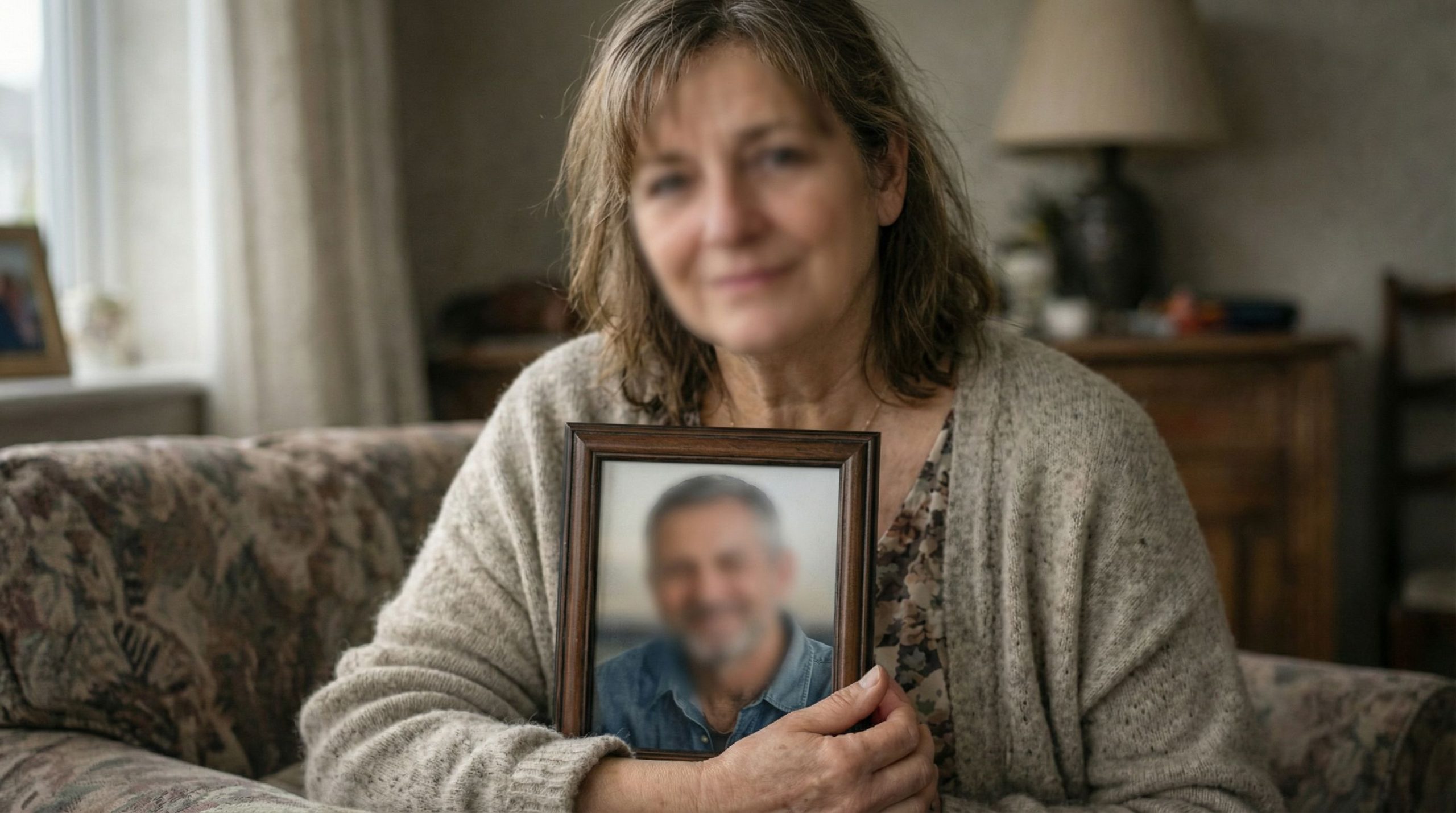
Would you have the courage to sit at the entrance to a grocery store, a small box in your hand, begging for money from passersby? That’s the extreme measure Geneviève Coutu had to resort to. Not for herself, but for Louis, her husband. Suffering from early-onset Alzheimer’s disease and passing away last fall at the age of 56, he was able to stay at home until his last breath thanks to her. But at what cost? After exhausting her savings and teetering on the brink of financial ruin, this Sorel-Tracy resident is now fighting a crucial battle: to have the invisible work of caregivers recognized with a real salary.
Love doesn’t pay the bills
For five years, Geneviève was Louis’s arms, legs, and memory. Starting in 2021, the situation became more complicated: her husband « became like a child again, » unable to walk or eat on his own. For Geneviève, placing him in a long-term care facility was unthinkable as long as she was able to stand on her own two feet. So she quit her job. The problem? Employment insurance only supported her for about 40 weeks. After that? Nothing. Despite a small disability pension and a little help at home, the bills piled up. That’s when she had to appeal to the generosity of the public, in person and on TikTok, sharing her daily life without embellishment. An embarrassing step, she admits, but necessary to avoid placing the man of her life in a facility. $40,000 versus $118,000: the calculation is easy to make. credit: saviezvousque.net (AI image) Today, Geneviève asks an uncomfortable question: will the government continue to rely on families for free? She proposes a solution with figures: a net salary of $800 per week for caregivers, or about $40,000 per year. Does that seem like a lot? Let’s look at the Auditor General’s figures. A place in a public long-term care facility costs $118,000 per year, of which $98,000 comes directly from the government’s pockets. By keeping their loved ones at home, caregivers save the community huge amounts of money. And there is an urgent need for action. The Institute for Research and Socioeconomic Information (IRIS) warns that with an aging population, the cost of long-term care could triple by 2050 to reach $25.6 billion. Geneviève sums up the situation simply: without caregivers, thousands of CHSLDs would have to be built… without the staff to run them.
Quebec and Ottawa with their backs against the wall
credit: saviezvousque.net (IA image) Her fight is starting to make waves. Geneviève has launched two petitions. The first, addressed to Quebec City, has collected more than 7,000 signatures. The second, aimed at the federal government with more than 13,000 signatures, is sponsored by Bloc Québécois MP Louis Plamondon. It calls on Ottawa to extend employment insurance benefits, currently limited to 15 weeks for a sick adult (compared to 35 weeks for a child). Things are also moving in Quebec City. Minister Sonia Bélanger is set to unveil her new home support policy on Thursday. Loriane Estienne, from Proche aidance Québec, sees this as a golden opportunity to finally make a serious investment. « My husband’s illness will not have been in vain, » hopes Geneviève. In Quebec, 1.5 million caregivers are waiting to see if the message has been heard.
According to the source: ici.radio-canada.ca Created by humans, assisted by AI.